

THE BREAKTHROUGH LOOP
You're still not getting the results you know you should. This is why.
The hardest version of stuck isn't not knowing what to do. It's knowing exactly what to do and still not being able to act.
You know that moment.
You're about to make the important call. Start the diet. Begin the training. Make the change you've been circling for weeks.
And you don't.
Not because you decided not to. Because something in you just didn't. A reason appeared. A crisis surfaced. The moment passed and you told yourself there'd be another one.
This isn't always your conscious mind making that call.
Sometimes the friction appears before you even understand why.
You can consciously want the outcome. You can understand the strategy. You can have the resources, the ability and even a clear plan.
And still, when the moment arrives, something changes.
The task suddenly feels heavier. Another priority becomes more important. You decide you need a little more information. The timing doesn't feel quite right.
None of those reasons have to be fake. That's what makes the pattern difficult to see.
Your brain and nervous system are constantly using past experience, your current state and the situation you're in to anticipate what happens next and prepare you to respond.
Most of the time, that process is useful. But it also means that what you consciously want and what your system is prepared to move towards are not always perfectly aligned.
And the reason may not be obvious.
It could be associated with risk, loss, identity, uncertainty, security, effort, social consequences, or something you would never consciously identify as the problem.
Trying to find the one hidden explanation can become its own trap.
Breakthrough Mastery takes a different approach.
Rather than assuming you need more discipline, a better strategy, or the perfect psychological explanation, we look at what happens when you meet friction and what makes a different response possible.
The Breakthrough Loop is a working model for that process.
It maps several recurring patterns involved in regulation, friction, openness, adaptation and integration. These aren't rigid neurological stages, and they don't happen once across your life.
They can show up differently across different domains.
You might have enormous capacity in your work while repeatedly getting stuck in relationships, health, creativity, or a decision you've been circling for years.
Growth is a physiological process, not a motivational one.
The science here is more nuanced than a single theory or pathway.
Your capacity for learning, adaptation, decision-making and sustained change is influenced by the state of your nervous system, particularly the way your brain and body are responding to the demands of the moment.
The autonomic nervous system is part of that process. It continuously helps regulate arousal, attention, energy use, heart rate, breathing and other functions in response to what is happening inside and around you.
Polyvagal Theory, developed by Stephen Porges, has been influential in popularising the idea that different autonomic states can shape how available connection, flexibility and adaptive behaviour feel. Some aspects of the theory remain debated, so I use it as one useful model rather than as a complete explanation of human behaviour.
More broadly, decades of research across stress physiology, affective neuroscience, predictive processing, learning and behaviour show something important: your state changes what is available to you.
When you are well regulated and have sufficient capacity, it is generally easier to think flexibly, tolerate uncertainty, consider alternatives, regulate emotion and remain open to new information.
When you are under significant stress or threat, attention tends to narrow. Behaviour becomes more biased toward what feels familiar, urgent or protective. Working memory, cognitive flexibility and complex decision-making can become less available.
That does not mean your higher brain simply “switches off,” or that your nervous system alone determines what you can and cannot do.
It means that the same person, with the same knowledge and the same intentions, can respond very differently depending on state, context, prior learning and the meaning their system is assigning to what is happening.
This is measurable physiology, but it is also more than physiology alone.
Your behaviour emerges from the interaction between your nervous system, your expectations, your learning history, your environment, your current resources and the situation you are facing.
That is why Breakthrough Mastery does not reduce stuckness to discipline, mindset or nervous-system regulation alone.
Baseline regulation matters because it affects how much flexibility and capacity you can bring to the moment. But breakthrough also involves recognising friction, remaining open long enough to respond differently, experimenting with new behaviour and integrating what works.
What the animation below shows is a working model of that process, not a literal biological sequence.
The biology involved spans multiple systems simultaneously, and no five-phase framework can capture the full complexity of human adaptation. The value of the Breakthrough Loop is that it gives us a practical way to recognise recurring patterns and ask better questions about what may help movement become possible.
And because these patterns are domain-specific, you can have enormous capacity in one part of your life and repeatedly get stuck in another — whether that is business, relationships, health, creativity, grief, or something you have been circling for years.
The five phases of the Breakthrough Loop.
PHASE 1: Regulation and Safety
Every loop begins here. Not with motivation, not with a goal, not with a strategy, but with a nervous system that is regulated enough to engage with what comes next.
Regulation does not mean being calm or relaxed all the time. It means having sufficient capacity to remain engaged, flexible and responsive as demands increase.
When that capacity is available, you can think clearly, tolerate uncertainty and discomfort, stay connected to what matters, take in new information and choose from a wider range of responses.
When regulation is insufficient, that range tends to narrow. Attention becomes more constrained, familiar protective responses become more likely, and it becomes harder to remain open and adaptive when friction appears.
This capacity is sometimes described through the idea of a “window of tolerance”: the range of activation within which you can stay engaged without becoming overwhelmed, highly reactive or shutting down.
The biology behind regulation involves multiple interacting systems. Autonomic flexibility, including vagal activity and measures such as heart-rate variability, is part of that picture, but there is no single biological marker that tells us whether someone is “regulated.”
And regulation is not fixed.
Sleep, breathing, movement, circadian rhythm, nutrition, social connection, recovery, environmental cues and repeated experiences of successfully meeting challenge can all influence the baseline capacity you bring to the next moment.
This is why regulation is Phase 1 of the Breakthrough Loop.
Every breakthrough begins from the capacity already available to the system. The stronger and more flexible that baseline, the greater the capacity to meet the futility and friction that inevitably arise as an existing way of responding reaches its limit.
PHASE 2: Futility and Friction
This is the phase people most often misread. And that misreading can keep them stuck.
Futility begins when the system encounters a mismatch between what it expected and what is actually happening.
Your brain is constantly using past experience to generate predictions about what is likely to happen next. When reality differs from those predictions, the mismatch creates what neuroscience often describes as prediction error.
Sometimes that mismatch is useful and easy to absorb.
Sometimes it is repeated, emotionally significant, or large enough that the existing model can no longer explain what is happening.
That is where futility can begin.
It may feel like heaviness, pointlessness, frustration, disappointment, or a strong urge to stop.
Research implicates the habenula and related reward and aversion networks in signalling disappointing outcomes and reducing approach behaviour when expected rewards fail to appear. But futility is not produced by one structure or one chemical pathway. It emerges from a broader interaction between prediction, reward, motivation, learning, arousal and context.
And importantly, futility does not require complete failure.
You can be making progress and still experience it.
If the result is substantially less than expected, if effort stops producing the return you anticipated, or if the strategy that used to work stops working, the system may begin signalling that the current approach is no longer sufficient.
That signal is not a character flaw.
It is information.
Something about the existing model, expectation, strategy or response is no longer matching reality closely enough.
This is also where people often try to escape the process.
Another framework. Another tool. Another plan. Another burst of motivation.
None of those things are inherently wrong.
But when they are used primarily to avoid the discomfort of discovering that the current approach is no longer enough, they can delay the very adaptation that is required.
Futility matters because it creates pressure for revision.
The existing way of responding has reached a limit.
Something has to change.
This is where friction appears.
Friction is the tension between what is already well learned and what the situation now requires.
The familiar response is still available. Often it is fast, efficient and automatic.
But another possibility has begun to appear.
You can see a different option. You may even know exactly what you want to do instead.
And yet the old response still has momentum.
That can feel like resistance, hesitation, irritation, self-doubt, avoidance, overthinking, procrastination, or a sudden pull toward something easier and more familiar.
You do not need to assume that two literal neural “models” are sitting side by side in the brain.
But at a functional level, that is often what the experience resembles: an established pattern remains highly available while a newer response is not yet stable enough to compete with it easily.
That instability is friction.
At this point, biology matters, but biology does not determine the outcome by itself.
Two people can encounter very similar futility and friction and respond very differently.
Two things become especially important.
The first is baseline regulation.
If the system has enough capacity to remain engaged, it can stay in contact with the discomfort for longer without immediately retreating into the familiar response.
The second is interpretation.
Futility can be interpreted as:
This isn't working. Stop.
Or:
This way of doing it has reached its limit. Something needs to change.
Friction can be interpreted as:
This feels difficult, so it must be wrong.
Or:
Of course this feels difficult. The old response is still easier than the new one.
That distinction matters.
When futility and friction are interpreted only as evidence of failure, the system is more likely to retreat toward what is familiar.
When they are recognised as information, another possibility opens.
Futility tells you that the current model or response is no longer sufficient.
Friction tells you that change is now demanding something different from you.
This is the hinge point in the Breakthrough Loop.
The old response has stopped being enough.
The new one is not yet established.
What happens next depends on whether the system can remain engaged long enough for curiosity and openness to emerge.
PHASE 3: Curiosity and Openness
Curiosity and openness are not fixed personality traits. They are states that become more available when the system is regulated enough to move beyond immediate protection and remain engaged with uncertainty.
In Phase 2, the brain encounters futility and friction. The existing response is no longer producing the expected result, but the new response is not yet established.
What happens next depends partly on whether the system can stay engaged with that mismatch rather than retreating immediately to what is familiar.
When futility and friction are interpreted as threat or failure, attention tends to narrow. The system becomes more defensive, more certain, and more likely to repeat established responses.
When they are recognised as information, something different becomes possible.
The question begins to shift from:
Why isn't this working?
to:
What else could be true?
What haven't I noticed?
What could I try differently?
That shift is curiosity.
Curiosity does not necessarily arrive as excitement, inspiration or optimism.
It may appear as a slight reduction in resistance. A willingness to pause before reacting. A moment where you become less invested in defending the existing explanation. A genuine question replacing a familiar conclusion.
That is important because learning requires some degree of openness to information that does not fit the current model.
When curiosity is available, attention can broaden. Alternatives become easier to consider. New information can be taken seriously rather than dismissed simply because it conflicts with what is already familiar.
The system becomes more capable of exploration.
This is not the same as forcing yourself to “think positively.”
You can repeat a new belief while the rest of the system remains organised around the old response.
Curiosity works differently.
It does not require you to decide in advance what the answer should be.
It creates enough openness to discover something you could not see while you were defending the existing model.
And this can often be deliberately supported.
Questions such as:
What else could this mean?
What am I assuming right now?
What would I notice if I weren't trying to prove my current explanation?
can help interrupt an automatic interpretation and create room for another one.
But the question only becomes useful when there is enough regulation to genuinely consider the answer.
That is why curiosity follows futility and friction in the Breakthrough Loop.
Phase 2 disrupts the old certainty.
Phase 3 creates the openness required for something new to emerge.
Curiosity is the transition from recognising that the existing response is no longer enough to becoming genuinely available for adaptation.
Once that openness is present, the system can begin testing new responses.
That is where Phase 4 begins.
PHASE 4: Adaptation and Learning
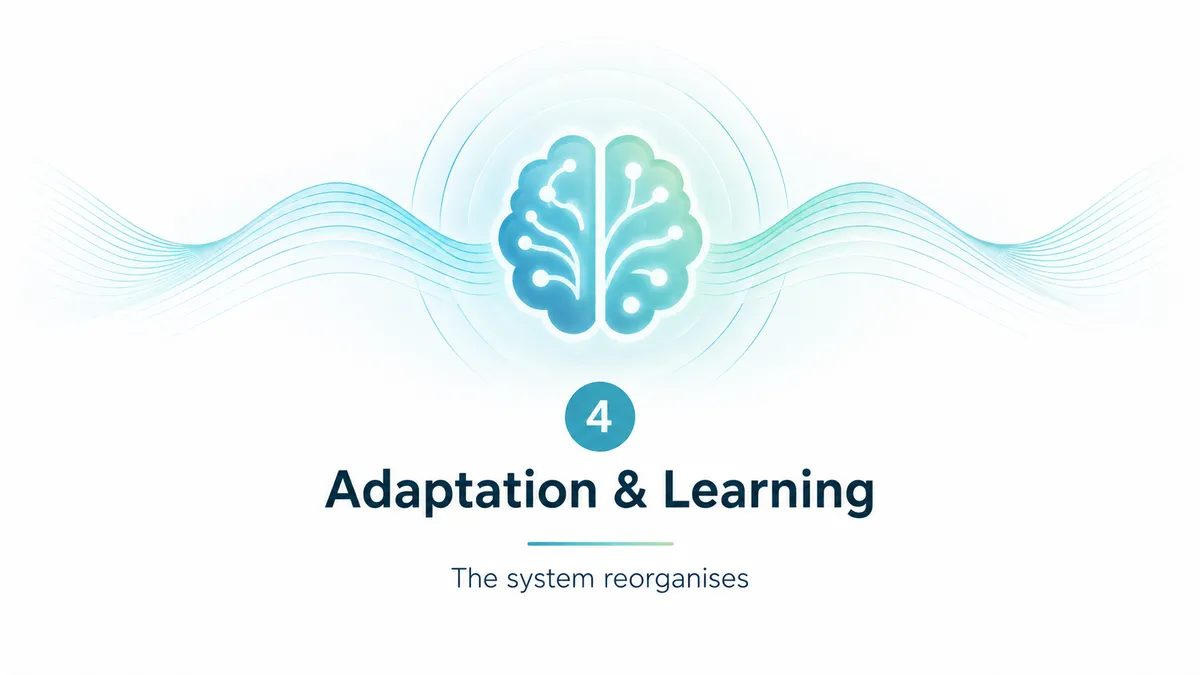
When curiosity creates an opening, the system can begin testing new responses and learning from what happens next.
This is possible because the person has remained engaged through futility and friction rather than immediately retreating to the familiar pattern.
The prediction error has not disappeared. It has become usable. Instead of simply signalling that the old approach is failing, it now creates an opportunity to experiment.
This is where adaptation begins.
The brain is constantly changing in response to experience. Repeated patterns of attention, behaviour and interpretation can strengthen some neural connections and make particular responses easier to access in the future.
That process is broadly described as neuroplasticity.
Neuroplasticity is not something that suddenly “switches on” in this phase. It is happening throughout life.
What changes here is that the system is now in a better position to use experience to build a different response.
A new behaviour is attempted.
A different interpretation is tested.
The person stays in the conversation instead of withdrawing.
They tolerate the uncertainty.
They act before they feel completely ready.
And then the brain receives new information.
The important part is not simply that the behaviour was different.
It is that the outcome provides evidence the system can learn from.
Sometimes the result is better than expected.
Sometimes nothing catastrophic happens.
Sometimes the person discovers they can tolerate far more discomfort than they predicted.
And sometimes the attempt fails, but in a way that produces better information than avoidance ever could.
That is adaptation.
The challenge needs to be sufficient to create learning without becoming so overwhelming that the person loses the capacity to remain engaged.
This does not mean there is one perfect biological “zone” for growth.
It means that learning tends to be more effective when challenge is demanding enough to require adaptation but still manageable enough for the person to continue participating.
This is why simply pushing harder is not always useful.
If the challenge repeatedly exceeds available capacity, the person is more likely to fall back into familiar protective responses.
But if the new response is practised in a form that can actually be repeated, the system begins accumulating evidence that another way of responding is possible.
Each successful attempt makes the new behaviour more available, and what initially requires considerable attention and effort can gradually become easier, faster and more familiar.
The predictive model begins to update.
What once felt unlikely may start to feel possible.
What once felt dangerous may begin to feel manageable.
What once required enormous effort may become ordinary.
Over time, this can also change how a person understands themselves.
Not because they repeated an affirmation about who they wanted to become, but because their own experience has started producing evidence for a different conclusion.
They are no longer simply imagining a different response.
They have begun living one.
That is the transition from adaptation into the final phase of the loop: integration, consolidation and growth.
PHASE 5: Ascension and Growth
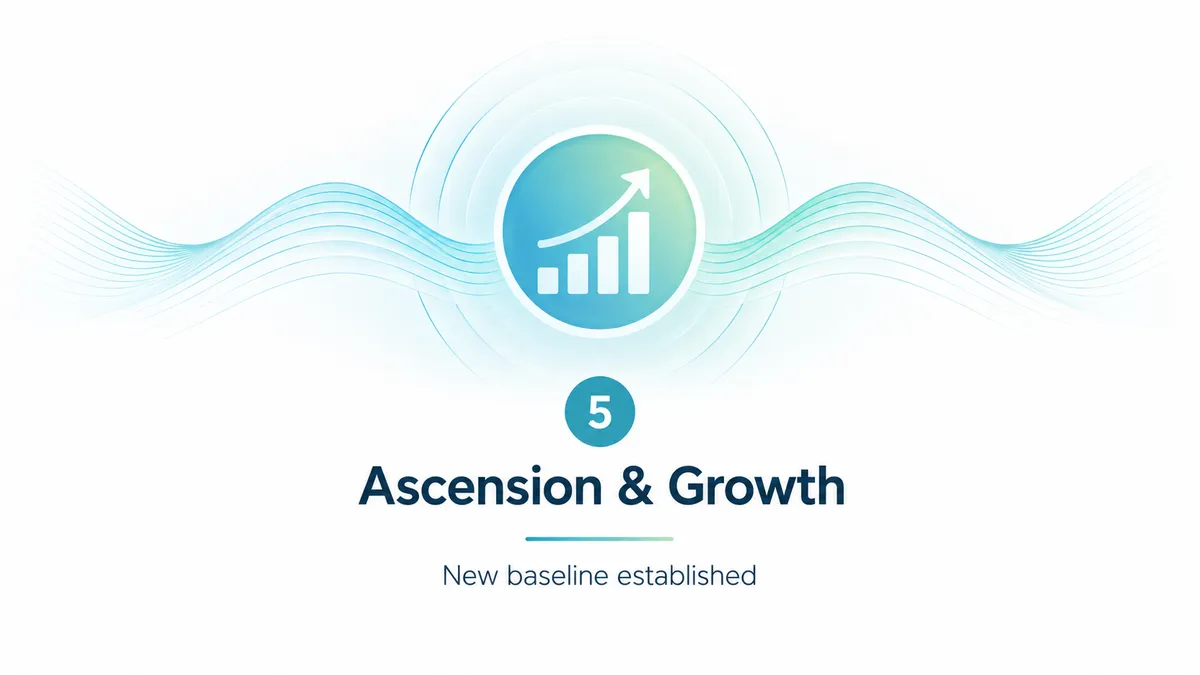
Ascension is the phase where a new response begins to stabilise and become easier to access.
The person has moved through the earlier phases of the loop. Futility has been encountered rather than immediately escaped. Friction has been tolerated. Curiosity has created openness. New responses have been tested and repeated.
What initially required effort begins to become more familiar.
This is where integration matters.
Learning is not strengthened by constant effort alone. The brain also needs periods in which experience can be consolidated.
Sleep plays an important role in that process. During sleep, newly acquired information is reorganised and stabilised across memory systems. Experiences from the day are integrated with existing knowledge, and patterns that have been repeatedly reinforced can become easier to retrieve in the future.
Integration also happens while awake.
Periods of lower demand, reflection, walking, breathing, conversation and reduced stimulation can create space for the system to process what has happened rather than immediately moving on to the next challenge.
This does not mean the brain is simply “recalibrating its baseline settings” in one neat biological process.
The change is distributed.
Learning, memory, autonomic regulation, expectation, behaviour and context all contribute to whether the new response becomes more available over time.
The important shift is functional.
What once felt difficult can begin to feel manageable.
What once required deliberate effort can become easier.
What once triggered hesitation or avoidance may no longer produce the same response.
And the person begins to accumulate evidence that they can move through this kind of challenge successfully and every completed loop can increase future capacity.
Futility and friction become less mysterious.
The person becomes quicker at recognising what is happening.
Curiosity becomes easier to access.
Adaptation becomes less threatening.
The system develops a broader repertoire of responses and greater confidence in its ability to recover, adjust and continue.
This is why growth can compound.
The result is not that challenge disappears.
It is that the person becomes more capable of meeting challenge without automatically collapsing back into the same pattern.
And as this process repeats, what was once a breakthrough can gradually become the new normal.
Why the breakthrough loop so often fails to complete.
Understanding the loop is not enough. What matters is understanding what happens when the loop reaches its most difficult point.
The critical point is Phase 2.
When futility and friction arise, the system has reached the limit of an established way of responding. Something is no longer producing the expected result, but the alternative is not yet stable.
This creates a vulnerable moment.
If there is enough baseline regulation, the person can remain engaged with the discomfort. Futility can be recognised as information rather than interpreted as proof of failure. Friction can be tolerated long enough for another response to become possible.
That creates the conditions for curiosity and openness to emerge, and the Breakthrough Loop can continue.
But that is not the only possible outcome.
Phase 2 is also where the process can stall or move backwards.
When available capacity is too low, attention narrows. Stress and arousal increase. Familiar protective responses become more compelling. The person becomes more likely to avoid, withdraw, delay, defend, overthink or return to whatever has previously reduced the discomfort.
Futility starts to feel like:
This isn't working.
I'm not capable of this.
There's no point continuing.
And friction starts to feel like evidence that something is wrong:
This shouldn't be this difficult.
Maybe this isn't right for me.
I'll come back to it when things settle down.
The reasons that appear at this point can be completely plausible.
The person may genuinely have other priorities. The timing may genuinely be inconvenient. More information may genuinely be useful.
That is what makes the pattern difficult to recognise.
What matters is what happens next.
If the person remains engaged, curiosity can emerge and the Breakthrough Loop continues.
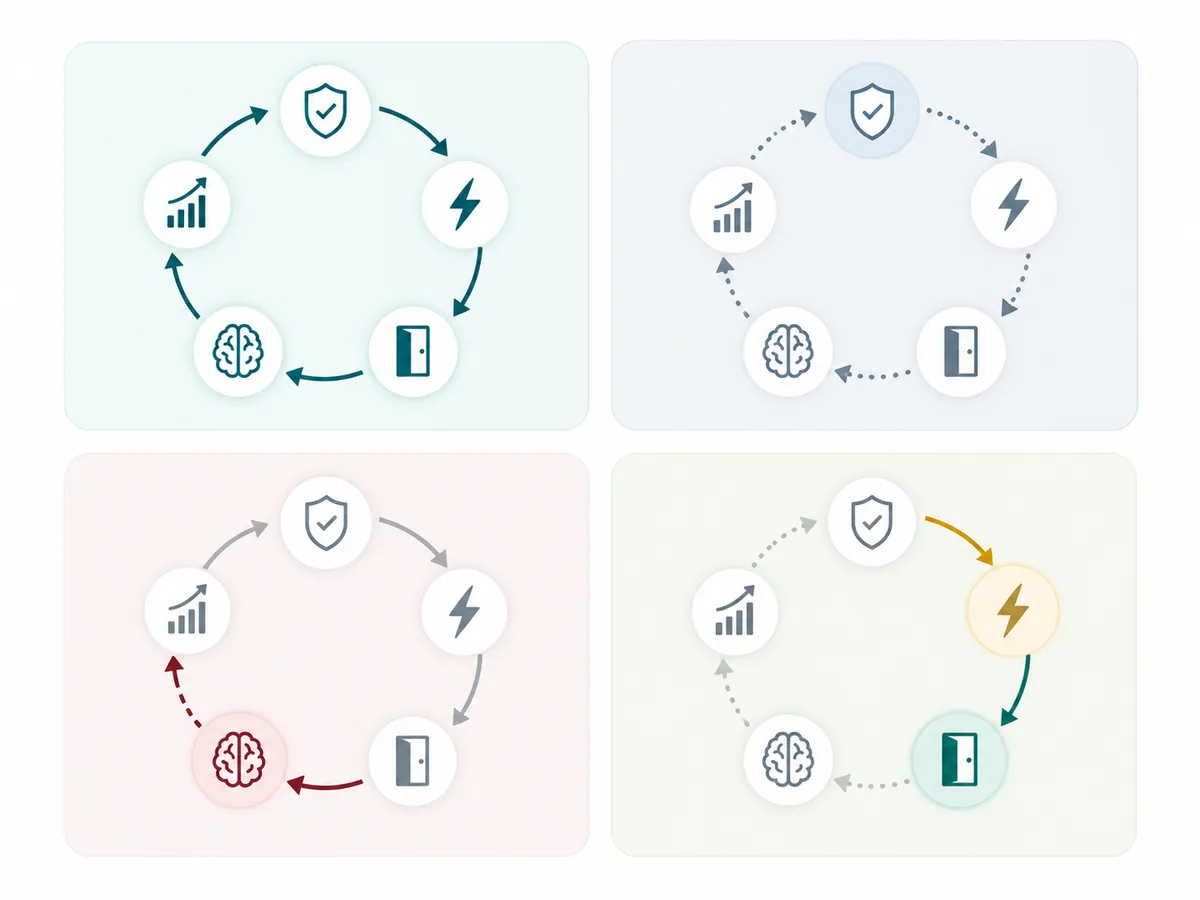
If they lose momentum without fully retreating, the system can settle back into the same familiar baseline. The same ceiling remains in place and the pattern repeats. I call this the Plateau Loop.
If futility and friction are interpreted as threat and the person retreats further into protection, avoidance or defensive behaviour, the pattern can become more entrenched. I call this the Regression Loop.
So Phase 2 is not simply the difficult part of the Breakthrough Loop.
It is the point at which one process can resolve in three different ways:
Breakthrough — the system remains engaged and adapts.
Plateau — the system stalls and returns to the same baseline.
Regression — the system retreats and the protective pattern strengthens.
This is not simply a question of discipline or commitment.
The same person can meet the same challenge differently depending on how much capacity they have available at the time, how familiar the situation feels, what they predict will happen, and how they interpret the discomfort that arises.
That is why baseline regulation matters so much.
It does not determine the outcome on its own.
But it strongly influences whether the system has enough flexibility to stay engaged when futility and friction arrive — and therefore which loop is most likely to complete.
Tap Regulated or Dysregulated to see the difference.
The loops run continuously, across every domain of your life.
hese patterns do not operate uniformly across your life.
Your work, relationships, health, creativity and finances can each be running very different loops at the same time.
You may be moving through a Breakthrough Loop in one domain, sitting in a Plateau Loop in another, and repeatedly falling into a Regression Loop somewhere else.
That is normal.
Capacity is highly context-dependent.
Someone can be confident, flexible and adaptive at work while becoming reactive or avoidant in a relationship. Another person may handle relationships easily while repeatedly stalling around health, money or creative work.
The person has not changed.
The context has.
Different domains carry different histories, expectations, learned responses and levels of available regulation. Competence in one area does not automatically transfer to another.
Your overall capacity also changes from day to day.
Sleep, stress, workload, physical health, relationships and the number of demands competing for your attention all influence how much flexibility you have available.
That is why a challenge you could normally move through may suddenly feel much harder when the rest of your system is already carrying too much.
It is also why trying to force progress across every area of life at once can backfire.
The practical question is not simply:
Where am I in the Breakthrough Loop?
It is:
What loop is running in this domain right now, and what would help it move differently?
Over time, a domain that once produced repeated plateau or regression can begin to produce more breakthrough.
What once required deliberate effort becomes more familiar.
Capacity increases.
And eventually, you meet the next edge.
The process begins again.
This is where the work begins.
Most people who reach this point in the page have already recognised the pattern in their own experience.
The pattern that reappears regardless of how hard you've tried to shift it. The phases of futility that felt like failure but were actually the loop trying to complete. The periods of friction that triggered retreat just before adaptation was possible.
That recognition is not incidental. It is the beginning of a different relationship with your own biology.
Understanding the model is one thing. Building the nervous system capacity to move through it consistently is another.
That is the work Breakthrough Mastery is designed to support.
Copyrights 2026 | BreakthroughMastery | Privacy
Facebook
Instagram
Youtube