THE BREAKTHROUGH LOOP

You're still not getting the results you know you should. This is why.

The hardest version of stuck isn't not knowing what to do. It's knowing exactly what to do and still not being able to act.

You know that moment.

You're about to make the call. Start the diet. Begin the training. Make the change you've been circling for weeks.

And you don't.

Not because you decided not to. Because something in you just didn't. A reason appeared. A crisis surfaced. The moment passed and you told yourself there'd be another one.

This isn't your conscious mind making that call.

It's stored stress. The accumulated weight of every loss, every setback, every moment things went wrong, held in your nervous system, not your memory. And it is making decisions on your behalf.

This happens two ways.

Some people have had real runs of momentum. Everything coming together the way it should. Then the losses came. The setbacks. The moments where things went wrong often enough that the nervous system started keeping score.

Others have never quite found that footing. Without enough reference points for what success actually feels like, forward movement has never felt safe enough to sustain.

Different histories. The same response.

Your nervous system is not assessing your potential. It's assessing the evidence. And when that evidence is insufficient, whether it was eroded or never built, it reads forward movement as risk and protects you from it.

That's not a discipline problem. It's not a strategy problem. And it won't respond to the approach you've already tried.

It requires a different kind of capacity. The Breakthrough Loop maps how that capacity is built. It is a neuroscience-based framework that tracks the biological cycle your nervous system moves through during genuine growth, and explains not just how change happens, but why it so often doesn't.

The model maps five phases of adaptation, learning, and growth. Each phase serves a specific neurological function.

This loop does not run once across your life. It runs in parallel across multiple domains. Your business, relationships, health, and identity each at different rates, with different levels of available capacity.

Growth is a physiological process, not a motivational one.

The science is unambiguous on this. Your capacity for learning, adaptation, and sustained change is governed by your autonomic nervous system. The ancient, largely automatic system that regulates your internal state in response to your environment.

This system operates according to principles first mapped by neurobiologist Stephen Porges in his Polyvagal Theory, and developed further through decades of research in neuroscience, trauma biology, and adaptive learning. What this research shows, consistently, is that your nervous system state determines what is possible for you at any given moment.

When your system detects safety and your autonomic baseline is regulated, your prefrontal cortex remains fully online. You can think clearly, tolerate uncertainty, make complex decisions, and remain open to new information. Learning and adaptation become available.

When your system detects threat, whether that threat is physical, social, financial, or relational, resources are redirected. Blood flow shifts away from the prefrontal cortex and toward the more primitive survival structures of the brain. Higher-order thinking goes offline. Creativity, strategic reasoning, and emotional regulation all diminish. The system narrows its focus to immediate survival.

This is not a metaphor. It is measurable physiology.

And it means that your capacity for growth is not primarily a function of your intelligence, your discipline, or the quality of your strategy. It is a function of your nervous system's baseline regulation, the internal foundation that determines what your biology can support at any given moment.

What the animation below shows is a working model, not a complete one. The biology involved spans multiple systems simultaneously and is shaped by factors no five-phase loop can fully capture. The loop is useful because it points toward the right questions. The mechanisms behind it go considerably deeper.

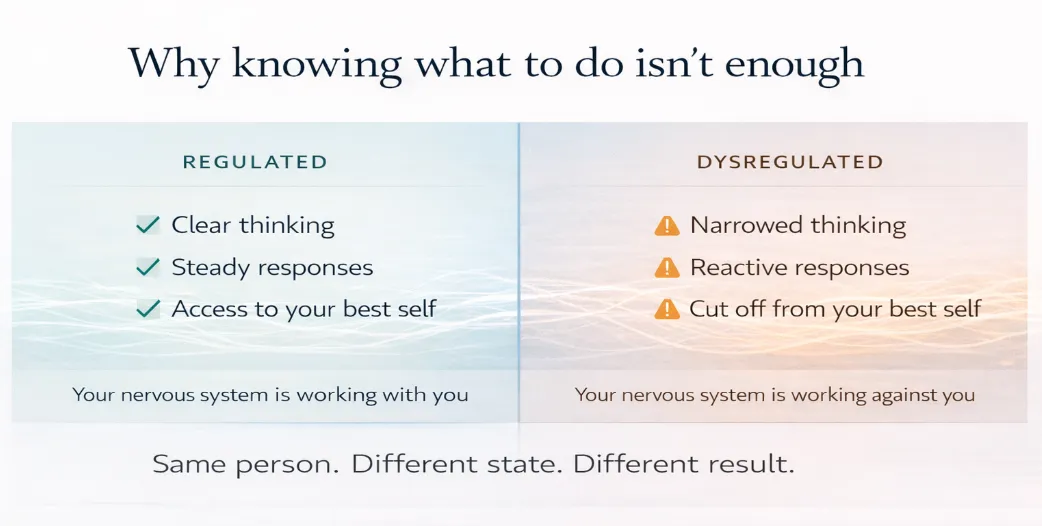
Tap Regulated or Dysregulated to see the difference.

The Breakthrough Loop

Baseline regulation determines whether each loop completes or collapses

The five phases of the Breakthrough Loop.

PHASE 1: Regulation and Safety

Every loop begins here. Not with motivation, not with a goal, not with a strategy, but with a nervous system that is regulated enough to engage with what comes next.

Regulation does not mean calm in the passive sense. It means your autonomic system is operating within what researchers call the window of tolerance. A range of activation where the prefrontal cortex remains online and higher-order functioning is available. Within this window you can think clearly, connect with others, tolerate discomfort, and remain open to new information.

The biological marker of this state is vagal tone. The activity of the vagus nerve, which runs from the brainstem through the heart, lungs, and gut, and is the primary pathway through which your nervous system signals safety to your organs. High vagal tone is associated with emotional resilience, cognitive flexibility, and the capacity to recover quickly from stress. Low vagal tone is associated with rigidity, reactivity, and difficulty adapting to change.

Vagal tone is not fixed. It can be built through specific practices such as meditation, breathwork, somatic awareness, circadian regulation, and the intentional cultivation of safety signals in the body and environment.

This is why regulation is not a luxury or a wellness practice. It is the physiologcal prerequisite for everything that follows in the loop. Without a regulated baseline, the subsequent phases cannot complete. The loop collapses before it can deliver growth.

PHASE 2: Futility and Friction

This is the phase people most often misread. And that misreading is what keeps them stuck.

Futility begins when the brain detects that its current model of the world is no longer producing the expected results. Neuroscientists refer to this as a prediction error. The brain is constantly generating models based on past experience and using them to anticipate outcomes. When reality no longer matches those expectations, the system registers a mismatch and initiates an update.

The habenula and associated neural networks play a central role in this process. When repeated prediction errors occur, these networks suppress dopamine activity and generate the internal experience of futility. It can feel like heaviness, pointlessness, or a strong urge to stop.

This response is not limited to complete failure. It can be triggered whenever the outcome is less than expected. Even when progress is being made, if the result falls short of what the brain predicted, the same networks can activate and produce the same internal signal.

This is not a character flaw. It is a physiological signal that the current model has reached its limit and requires revision.

It is also the phase that most approaches to personal development are built to help you avoid.

Another framework, another tool, another system. Each one offering a way to remain in the relative comfort of Engagement without having to tolerate what comes next. Positive thinking, visualisation, goal-setting, accountability structures, these are not wrong in themselves. But when they function as a way of bypassing the rupture rather than moving through it, they become sophisticated avoidance strategies. And avoidance doesn't protect the system. It keeps it fragile.

The rupture is necessary. It is the mechanism through which the current model breaks against reality and creates the conditions for a new one to form. This is how the nervous system actually grows, not through accumulation of better strategies, but through repeated cycles of rupture and repair. The capacity to tolerate the rupture, to remain regulated enough to stay in contact with the discomfort without retreating, is what determines whether growth completes or collapses.

Friction follows as the nervous system begins holding two competing models at the same time. The old pattern remains active while a new pattern starts to emerge. This creates a metabolically demanding state. Established neural pathways are efficient and require little energy, while new pathways are unstable and require more. The tension between them produces the experience of friction, which may show up as resistance, irritability, self-doubt, or a strong pull back toward what is familiar.

At this point, the experience is biological, but the outcome is not determined by biology alone. Two people can move through the same futility and friction and arrive at completely different results. What happens next is shaped by two factors. The first is baseline regulation. The second is how these signals are interpreted.

A regulated nervous system can remain engaged long enough to process what is happening. It can tolerate the discomfort of futility and the instability of friction without shutting down. This creates the conditions for the loop to continue.

Interpretation determines the direction from there.

Futility can be read as evidence that something is wrong, or as information that the current model has reached its limit and needs to change. Friction can be experienced as a warning to stop, or as evidence that two models are active at the same time and adaptation is already underway. When these signals are misinterpreted, the system retreats to familiar patterns. When they are understood correctly, the loop advances toward curiosity and adaptation.

Futility is the signal that the current model is no longer sufficient. Friction is the evidence that a new one is forming. This is the turning point in the loop, where growth either advances or collapses depending on whether the system can stay engaged and interpret the signals accurately.

PHASE 3: Curiosity and Openness

Curiosity and openness are not personality traits. They are physiological states that become available when the nervous system is no longer dominated by threat.

In Phase 2, the brain encounters prediction error in the form of futility and friction. How those signals are interpreted determines what happens next. When they are read as threat, the system contracts and returns to familiar patterns. When they are recognised as information and the system remains regulated enough to stay engaged, a different shift begins to occur.

As the nervous system processes the prediction error and stabilises, defensive activation starts to ease. The prefrontal cortex comes back online, and the system regains access to exploratory circuits. This is the point where curiosity becomes available.

Curiosity does not arrive as excitement or inspiration. It tends to appear more quietly — as a softening of resistance, a small question, or a moment of openness where the need to defend the current model begins to relax. It is less about seeking novelty and more about becoming willing to see differently.

This state cannot be forced through effort or positive thinking. If the nervous system is still treating the situation as a threat, the biology required for curiosity is not available. Attempts to override this often create more internal conflict and reinforce the protective response.

When curiosity is present, the system is no longer trying to confirm what it already believes. It becomes capable of updating. New information can be considered, alternative responses can be explored, and learning becomes possible again.

This is the hinge point in the loop. Curiosity marks the transition from protection to adaptation. Without it, the system cycles back into futility. With it, the loop can move forward into learning and change.

PHASE 4: Adaptation and Learning

When curiosity creates the opening, the nervous system can begin integrating new information and encoding new patterns.

This is only possible because the system has remained regulated enough to stay engaged through futility and friction. The prediction error has been processed rather than avoided, and the defensive response has eased. With the prefrontal cortex back online and exploratory circuits active, the brain is now in a state where learning can occur.

This is where neuroplasticity becomes active. The brain begins to physically rewire itself in response to experience.

Repeated new behaviours and responses strengthen emerging neural pathways through a process known as long-term potentiation. At the same time, pathways that are no longer reinforced begin to weaken through synaptic pruning. The system is not just thinking differently. It is becoming different at a structural level.

The research on behaviour change is consistent on one point. The nervous system learns through manageable challenge, not overwhelming stress. Too little challenge produces no learning. Too much challenge reactivates the protective responses encountered in Phase 2 and shuts the process down. The right level of challenge, often referred to as the zone of proximal development , allows adaptation to continue.

This is why pushing harder through willpower tends to fail at this stage. Large or sudden changes exceed the system's capacity and trigger the same protective patterns that were present during futility and friction. The loop collapses and the system returns to what is familiar.

Sustainable adaptation happens differently. It occurs through small, repeatable actions that the nervous system can process without perceiving as a threat. Each repetition provides evidence that the new pattern is viable, and that change can occur without destabilising the system.

As these small adaptations accumulate, the brain's predictive models begin to update. These models determine what is considered possible, what is considered safe, and how the system expects to respond. Over time, these updates shift identity. Not through intention or declaration, but through consistent biological evidence that supports a new way of operating.

PHASE 5: Ascension and Growth

Ascension is the phase where new patterns consolidate and become the new baseline.

This phase only occurs because the system has moved all the way through the earlier stages. Futility has been processed rather than avoided, friction has been tolerated, curiosity has opened the system, and new behaviours have been engaged. What was effortful begins to stabilise.

For this stabilisation to occur, the nervous system requires periods of reduced demand. Continuous activation, even when productive, limits the system's ability to reorganise. Learning does not come from constant effort alone. It comes from the cycle of engagement and integration.

During sleep, the brain processes the day's prediction errors and consolidates new learning through memory consolidation. Neural pathways that support new behaviours strengthen, while older patterns that are no longer reinforced begin to weaken. The autonomic nervous system recalibrates around these changes, adjusting its baseline settings to reflect what has been learned.

This process is also supported during waking states when the system is not under pressure. Moments of pause, reflection, and reduced stimulation allow the same integration to continue. Without these periods, the system remains in a state of activation and the consolidation of new patterns is less effective.

This is not temporary improvement maintained through discipline. It is structural change at the level of the nervous system. The new baseline becomes the reference point for future experience.

As this process repeats, each completed loop raises the system's capacity. The phases of futility and friction that once led to collapse become more familiar and more manageable. The system begins to recognise the pattern and develops trust in its ability to move through it. Growth compounds through repeated cycles of engagement and integration.

The mechanism behind the ceiling.

Understanding the loop is not enough. What matters is understanding why it so often fails to complete, and why that failure is biological rather than personal.

The collapse happens at Phase 2.

When futility and friction arise, the outcome depends on whether the nervous system can stay regulated enough to remain engaged. In a regulated state, these experiences are uncomfortable but workable. The prefrontal cortex stays sufficiently online to interpret the signals accurately, allowing curiosity to emerge and the loop to continue.

In a dysregulated state, the same signals trigger a stress response. Cortisol and adrenaline rise, the prefrontal cortex loses influence, and the system shifts into protection. The internal experience changes. Futility feels like failure. Friction feels like a threat. The pull back toward familiar patterns becomes difficult to resist.

When this happens, curiosity is not accessible. The biology that supports it is no longer available, and the system cannot interpret what is happening as part of the process. It can only respond by retreating.

The loop collapses at this point, and the system returns to what is known. The ceiling remains in place.

This is not a failure of discipline or commitment. It is a predictable physiological outcome of attempting growth without the capacity to support it. The same person, working toward the same goal with the same strategy, can produce very different results depending on their baseline state.

This is why baseline regulation is not a preliminary step. It is the condition that determines whether the process can unfold at all.

The loop runs continuously, across every domain of your life.

The Breakthrough Loop is not a linear process you move through once. It is a continuous biological cycle running across every domain of your life. Your business, your relationships, your health, and your identity all operate at different rates and sit in different phases at any given moment.

You might be in Ascension in your professional capability while in Futility in your relationships. You might be in Curiosity around a new approach to your health while in Friction around a long-standing business pattern. This is normal. Growth is domain-specific, and the nervous system builds competence in specific contexts rather than universally.

This has practical implications. Your energy and capacity are not unlimited resources that can be distributed evenly across every area at the same time. The nervous system has a finite bandwidth for processing novelty and managing change. When too many demands are placed on it at once, the system shifts into protection and the loop collapses.

Effective growth depends on recognising which loops have available capacity and which require support. A domain in Futility rarely responds to increased effort. It requires conditions that allow the nervous system to stabilise so it can re-engage with the process when resources are available.

This is the strategic value of the Breakthrough Loop. It provides a way to work with your biology rather than against it, so that change becomes sustainable and growth can compound over time.

This is where the work begins.

Most people who reach this point in the page have already recognised the pattern in their own experience. The ceiling that reappears regardless of strategy. The phases of futility that felt like failure but were actually the loop trying to complete. The periods of friction that triggered retreat just before adaptation was possible.

That recognition is not incidental. It is the beginning of a different relationship with your own biology.

Understanding the model is one thing. Building the nervous system capacity to move through it consistently is another.

That is the work Breakthrough Mastery is designed to support.

Copyrights 2026 | BreakthroughMastery | Privacy