
THE BREAKTHROUGH LOOP
Why capable people keep hitting the same ceiling, and what's actually happening when they do.
The Breakthrough Loop is a neuroscience-based framework that maps the biological cycle your nervous system moves through during genuine growth. Understanding it explains not just how change happens, but why it so often doesn't.
Growth is a biological process, not a motivational one.
The science is unambiguous on this. Your capacity for learning, adaptation, and sustained change is governed by your autonomic nervous system. The ancient, largely automatic system that regulates your internal state in response to your environment.
This system operates according to well-documented principles first mapped by neurobiologist Stephen Porges in his Polyvagal Theory, and developed further through decades of research in neuroscience, trauma biology, and adaptive learning. What this research shows, consistently, is that your nervous system state determines what is possible for you at any given moment.
When your system detects safety and your autonomic baseline is regulated, your prefrontal cortex remains fully online. You can think clearly, tolerate uncertainty, make complex decisions, and remain open to new information. Learning and adaptation become available.
When your system detects threat, whether that threat is physical, social, financial, or relational — resources are redirected. Blood flow shifts away from the prefrontal cortex and toward the more primitive survival structures of the brain. Higher-order thinking goes offline. Creativity, strategic reasoning, and emotional regulation all diminish. The system narrows its focus to immediate survival.
This is not a metaphor. It is measurable physiology.
And it means that your capacity for growth is not primarily a function of your intelligence, your discipline, or the quality of your strategy. It is a function of your nervous system's baseline regulation — the internal foundation that determines what your biology can support at any given moment.
The Breakthrough Loop is built on this foundation.
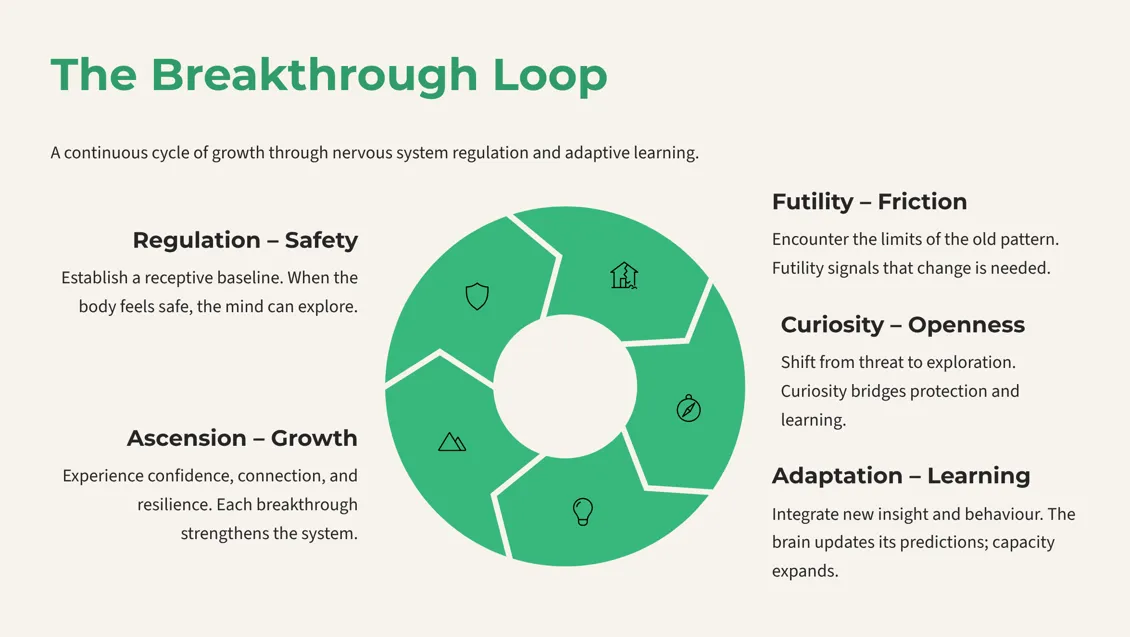
The Breakthrough Loop maps five phases of biological growth. Each phase serves a specific neurological function. The loop is continuous, running simultaneously across different domains of life, at different rates, completing at different times. Baseline regulation determines whether each loop completes or collapses.
The five phases of the Breakthrough Loop.
PHASE 1: Regulation and Safety
Every loop begins here. Not with motivation, not with a goal, not with a strategy — but with a nervous system that is regulated enough to engage with what comes next.
Regulation does not mean calm in the passive sense. It means your autonomic system is operating within what researchers call the window of tolerance — a range of activation where the prefrontal cortex remains online and higher-order functioning is available. Within this window you can think clearly, connect with others, tolerate discomfort, and remain open to new information.
The biological marker of this state is vagal tone — the activity of the vagus nerve, which runs from the brainstem through the heart, lungs, and gut, and is the primary pathway through which your nervous system signals safety to your organs. High vagal tone is associated with emotional resilience, cognitive flexibility, and the capacity to recover quickly from stress. Low vagal tone is associated with rigidity, reactivity, and difficulty adapting to change.
Vagal tone is not fixed. It can be built through specific practices — breathwork, somatic awareness, circadian regulation, and the intentional cultivation of safety signals in the body and environment.
This is why regulation is not a luxury or a wellness practice. It is the biological prerequisite for everything that follows in the loop. Without a regulated baseline, the subsequent phases cannot complete. The loop collapses before it can deliver growth.
PHASE 2: Futility and Friction
This is the phase most people misread — and the misreading is what keeps them stuck.
Futility arrives when your brain detects that its current model of the world is not producing expected outcomes. Neuroscientists call this a prediction error. Your brain is a prediction machine, constantly generating models of how the world works based on past experience. When reality contradicts those models, the brain registers a mismatch and initiates an update process.
The habenula — a small structure in the epithalamus — plays a central role here. When the brain detects repeated failure of its predictions, the habenula suppresses dopamine release and generates the internal experience of futility: the heaviness, the sense of pointlessness, the urge to stop. This is not a character flaw or a sign of weakness. It is a neurological signal that the current approach has reached its limit and something needs to change.
Friction follows as the nervous system begins running two models simultaneously — the old, familiar pattern and the emerging new one. This dual processing is metabolically expensive. Old neural pathways are efficient because they are well-myelinated. New pathways require more energy. The tension between them produces the internal experience of friction: irritability, resistance, self-doubt, the powerful pull back toward familiar patterns.
Most people interpret futility as failure and friction as a warning to stop. Both interpretations are wrong.
Futility is the brain's signal that an update is needed. Friction is the biological evidence that the update is in progress. Together they represent the most important juncture in the loop — the moment where genuine change either advances or collapses.
PHASE 3: Curiosity and Openness
Curiosity is not a personality trait. It is a physiological state.
Research in affective neuroscience identifies curiosity as an approach-oriented state associated with activation of the brain's exploratory circuits — distinct from the threat-oriented states that dominate during Futility and Friction. Curiosity requires prefrontal cortex availability, which means it requires a nervous system that is regulated enough to shift from protection mode back toward exploration.
This is why curiosity cannot be forced through positive thinking or motivational effort. When your nervous system is in a stress response, the biology that supports curiosity is simply not available. Attempting to manufacture curiosity while dysregulated creates internal conflict that deepens the activation rather than resolving it.
Curiosity emerges naturally when the nervous system has processed the prediction error of Futility and begun to stabilise after the reorganisation of Friction. It arrives not as excitement or inspiration but as small openings — a gentle question, a shift in perspective, a moment of wondering rather than defending.
This is the hinge point of the loop. Curiosity signals that the defensive response is easing, that the window of tolerance is widening, and that learning is becoming possible again. Without it, the loop returns to Futility. With it, the loop advances toward adaptation.
PHASE 4: Adaptation and Learning
When curiosity creates the opening, the nervous system can begin integrating new information and encoding new patterns.
This is where neuroplasticity — the brain's capacity to physically rewire itself in response to experience — becomes active.
Repeated new behaviours and responses strengthen emerging neural pathways through a process called long-term potentiation. Old pathways that are no longer reinforced gradually weaken through synaptic pruning.
The research on behaviour change is consistent on one point: the nervous system learns through manageable challenge, not overwhelming stress. Too little challenge produces no learning. Too much challenge triggers protective responses that shut down learning. The right-sized challenge — what researchers call the zone of proximal development — facilitates adaptation.
This is why the approach of pushing harder through willpower consistently fails at this phase. Large, sudden behaviour changes exceed the nervous system's processing capacity and trigger protective responses that make the new patterns impossible to sustain. Sustainable adaptation happens through small, repeatable actions that provide the system with evidence that change is possible without threatening its sense of stability.
Each small adaptation also updates the brain's predictive models — the internal representations of what is possible, what is safe, and what kind of person you are. Identity shifts not through declarations but through accumulated biological evidence.
PHASE 5: Ascension and Growth
Integration is the phase where new patterns consolidate and become the new baseline.
During sleep, the brain processes the day's prediction errors and consolidates new learning through memory consolidation. Synaptic connections that support new behaviours strengthen. Old patterns that have been replaced are gradually pruned. The autonomic nervous system recalibrates around new baseline settings.
The result is what researchers describe as upward drift — a genuine rise in baseline capacity that makes future challenges more manageable. The window of tolerance widens. Vagal tone improves. The prefrontal cortex remains online in situations that previously triggered shutdown. Decision quality improves. Resilience increases.
This is not temporary improvement maintained through effort. It is structural change at the level of the nervous system. The new baseline is the new normal.
And because each completed loop raises the baseline, subsequent loops become more navigable. The phases of Futility and Friction that previously derailed progress become recognisable and workable. The system develops trust in its own capacity to complete the process. Growth compounds.
The mechanism behind the ceiling.
Understanding the loop is not enough. What matters is understanding why it so often fails to complete — and why that failure is biological rather than personal.
The collapse happens at Phase 2.
When Futility and Friction arrive, the nervous system's response is determined almost entirely by its baseline regulation. A regulated nervous system experiences these phases as uncomfortable but workable. The prefrontal cortex remains sufficiently online to interpret the signals correctly — futility as information, friction as activation energy. Curiosity can emerge. The loop advances.
A dysregulated nervous system experiences the same phases very differently. The prediction error of Futility triggers a stress response. Cortisol and adrenaline rise. The prefrontal cortex loses influence over behaviour. The habenula suppresses dopamine and generates the subjective experience of hopelessness. The pull back toward familiar patterns becomes overwhelming.
In this state, Curiosity is not accessible. The biology that supports it — prefrontal availability, vagal tone, approach-oriented neural circuits — is offline. The system cannot muster the openness required to interpret friction as information. It can only experience it as threat.
So the loop collapses. The person retreats to familiar patterns. The ceiling stays in place.
This is not a failure of character, discipline, or commitment. It is a predictable physiological outcome of attempting growth without adequate nervous system capacity to support it.
The same person. The same goal. The same strategy. A different nervous system baseline produces a completely different result.
This is why baseline regulation is not a preliminary step before the real work begins. It is the real work. Everything else depends on it.
The loop runs continuously, across every domain of your life.
The Breakthrough Loop is not a linear process you move through once. It is a continuous biological cycle running simultaneously across every domain of your life — your business, your relationships, your health, your identity — at different rates and in different phases at any given moment.
You might be in Ascension in your professional capability while in Futility in your relationships. You might be in Curiosity around a new approach to your health while in Friction around a long-standing business pattern. This is normal. Growth is domain-specific. The nervous system builds competence in specific contexts, not universally.
What this means practically is that your energy and capacity are not unlimited resources to be distributed equally across every area simultaneously. The nervous system has a finite bandwidth for processing novelty and managing change. Attempting to force simultaneous transformation across multiple domains consistently exceeds that bandwidth and triggers the collapse mechanism described above.
Effective growth requires understanding which loops currently have energy available and which need supportive care rather than direct pressure. A domain in Futility rarely benefits from increased effort. It typically needs nervous system support — practices that build regulation capacity so the system can eventually re-engage with the process of change when resources are available.
This is the strategic intelligence the Breakthrough Loop provides. Not just an understanding of how change happens, but a map for working with your biology's natural rhythms rather than against them.
Find out where you are in the loop right now.
The most useful starting point is accurate self-knowledge. Not where you think you are. Not where you were last week. Where your nervous system is actually sitting right now — and what that means for your capacity to engage with what you're trying to build or change.
The Nervous System Check-In takes 90 seconds. Six simple observations about what your body is doing in this moment. No expertise required.
At the end you'll know your current state and receive a short guided practice designed specifically for where you are.
Takes 90 seconds. Free. No account required.
Copyrights 2026 | BreakthroughMastery | Privacy
Facebook
Instagram
Youtube